 Bahasa Indonesia
 English
- Alamat : Kampus Karangmalang, Yogyakarta, 55281
- Telp. (0274) 547780 psw 1343
- website : http://tp.fip.uny.ac.id
- e-mail: ktpfip@uny.ac.id
Fukuyama–UNY Academic Synergy: Collaborative Efforts Uncover Major AI Research Opportunities for the Next Generation
Primary tabs
Submitted by admin on Thu, 2025-11-13 12:56
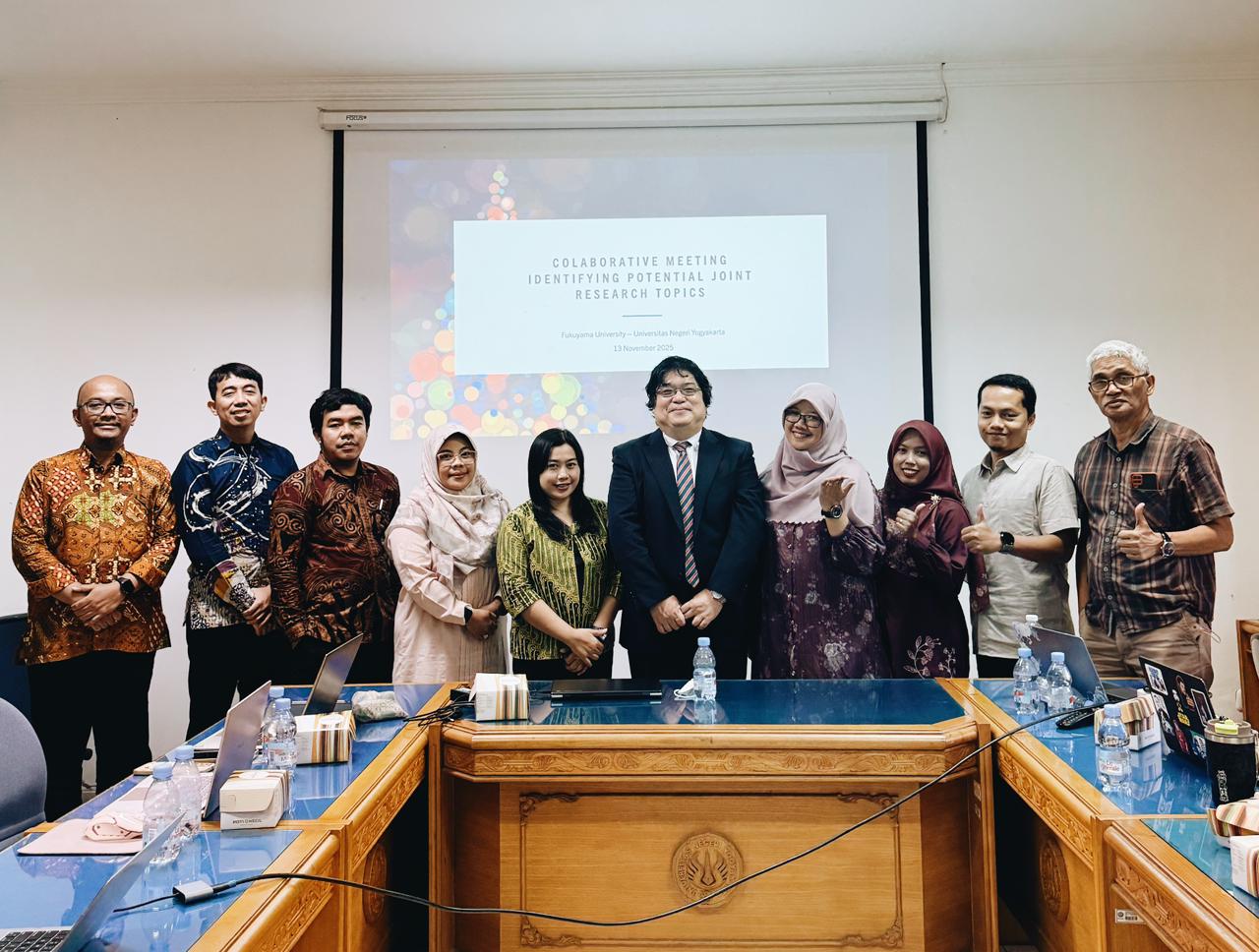
Yogyakarta – The Department of Curriculum and Educational Technology, Faculty of Education, Yogyakarta State University (UNY), continues to take strategic steps to strengthen its international network through a research collaboration with Japanese academics. In a session under the series titled “Collaboration Session,” the Faculty of Education welcomed Professor Kuhiniko Kaneko, Ph.D., from Fukuyama University, an expert in Artificial Intelligence (AI) and its applications in education.
This activity served as an important forum for both institutions to identify research directions that could contribute significantly to the development of education in Indonesia and Japan. During the intensive discussions held in the FIPP Meeting Room, both parties explored various potential research topics, including AI for learning analytics, AI-based teacher training, automated content generation, and the development of adaptive learning systems tailored to learners’ needs.
The event was attended by Dr. Sugeng Bayu Wahyono, M.Si., Dr. Sisca Rachmadonna, M.Pd., Dr. Suyantiningsih, M.Ed., Dr. Isniatun Munawaroh, M.Pd., Dr. Estu Miyarso, M.Pd., Ariyawan Agung Nugroho, S.T., M.Pd., Muhammad Ihsaan Fathoni, M.Pd., Dr. Mukhammad Luqman Hakim, M.Pd., Galih Pranowo, M.Pd., Sumiyati, M.Pd., and Luthfi Fahmi R, M.Pd.
The visiting professor from Japan presented several AI-based findings and technologies developed at his university, including more than 100 interactive AI learning resources available for international collaboration. He emphasized that cross-country research cooperation not only enriches academic perspectives but also accelerates impactful educational innovations. “Japan–Indonesia collaboration can bring forth AI approaches that are more inclusive and culturally relevant,” he said.
Beyond identifying research topics, the discussion also generated concrete opportunities for joint publications, student mobility programs, and the development of AI-based learning modules for prospective educators. Representatives from the Department of Curriculum and Educational Technology welcomed these collaboration prospects, particularly as they align with the university’s vision to strengthen digital transformation and enhance learning quality in the era of artificial intelligence.
This collaboration session is expected to be an initial step toward building a long-term partnership that not only produces academic output but also contributes to shaping a future generation that is technologically competent, adaptive, and ready to face global challenges.